
The U.S. job market in 2026 presents a complex picture—one that looks relatively stable at first glance but reveals deeper structural changes upon closer inspection. While traditional indicators like unemployment suggest resilience, underlying trends point to a labor market undergoing significant transformation.
A Low-Unemployment, Low-Hiring Economy
As of early 2026, the unemployment rate sits around 4.3–4.4%, a level economists generally consider healthy and close to “full employment.” (Bureau of Labor Statistics) Weekly jobless claims remain low, reinforcing the idea that widespread layoffs are not dominating the economy. (Reuters)
However, this stability comes with a caveat: hiring has slowed considerably. Job growth has been modest for over a year, and in some months, the economy has even lost jobs. (U.S. Bank) Economists often describe the current environment as a “low-hire, low-fire” equilibrium—companies are neither aggressively expanding nor cutting large portions of their workforce. (SIEPR)
The Shadow of 2025 Layoffs
The job market is still recovering from a turbulent 2025, when over 1.2 million layoffs were recorded—the highest since the pandemic era. (Yahoo Finance) Although layoff levels have moderated in 2026, they remain elevated compared to pre-pandemic norms, and fears of job loss continue to weigh on workers.
Even in 2026, employers announced over 60,000 job cuts in a single month, with the tech sector accounting for a large share. (Yahoo Finance) This reflects a broader shift in how companies manage labor in an uncertain economic environment.
The AI Effect: Efficiency Over Expansion
One of the most significant forces reshaping the job market is artificial intelligence. Companies are increasingly using AI to automate tasks, reduce costs, and improve efficiency—often without expanding their workforce.
Recent layoffs in major tech firms have been partially attributed to AI adoption, as businesses streamline operations and rely less on human labor for repetitive or routine work. (The Guardian) In fact, AI was cited as a contributing factor in roughly 25% of job cuts in early 2026. (Trading Economics)
This has led to a growing concern among economists: the possibility of a “jobless growth” economy, where companies generate higher profits without creating new jobs. (Business Insider)
A More Difficult Job Search
Despite relatively low unemployment, many job seekers report that finding work has become more challenging. Surveys show that the average unemployed person spends months searching, often facing repeated rejection and declining motivation. (New York Post)
Several factors contribute to this:
- More selective hiring practices
- Increased competition for fewer openings
- Greater emphasis on specialized or technical skills
- The growing role of AI in screening applicants
Younger workers and recent graduates are particularly affected, facing higher unemployment rates than the national average. (Reuters)
Wages and Worker Experience
For those who are employed, the situation is somewhat more positive. Wages are still growing modestly—around 3.8% annually—and in some cases outpacing inflation. (U.S. Bank)
However, other indicators suggest weakening conditions beneath the surface:
- Labor force participation has declined slightly
- More workers are employed part-time for economic reasons
- Long-term unemployment is rising (LinkedIn)
These trends indicate that while jobs exist, they are not always stable, full-time, or aligned with workers’ expectations.
Sector-Specific Growth
Job gains are increasingly concentrated in a few sectors, particularly:
- Healthcare and social assistance
- Government
- Certain service industries
Meanwhile, sectors like manufacturing and some areas of tech have shown signs of stagnation or decline. (Indeed Hiring Lab) This uneven growth contributes to mismatches between available jobs and worker skills.

The Trump Effect
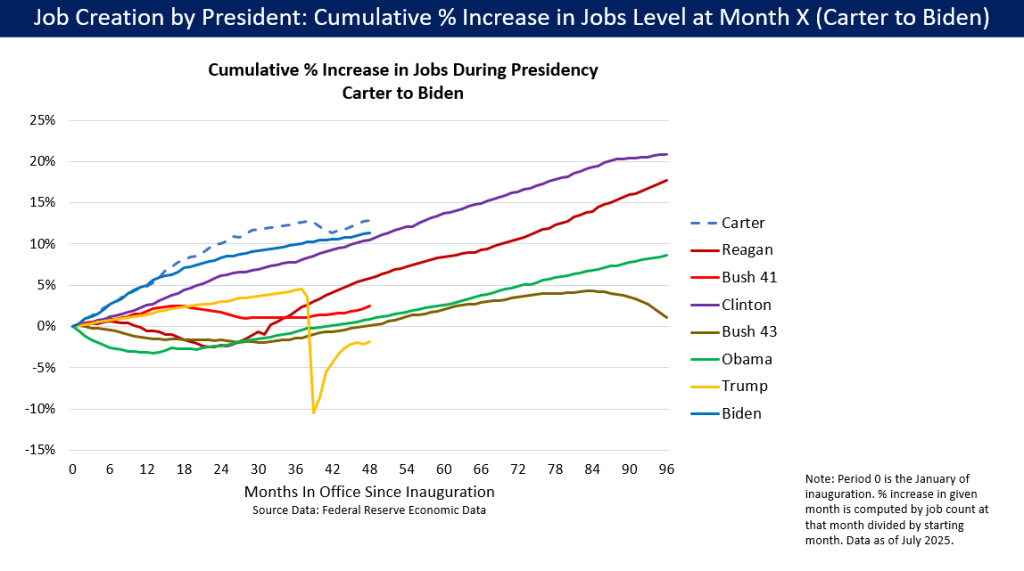
Donald Trump had a complex and often debated impact on the U.S. job market during and after his presidency. His administration emphasized tax cuts—most notably the Tax Cuts and Jobs Act—and deregulation, which supporters argue encouraged business investment, corporate hiring, and a period of low unemployment before the COVID-19 pandemic. At the same time, critics point out that many of the gains continued trends from prior years and disproportionately benefited corporations and higher-income workers. Trade policies, including tariffs on countries like China, aimed to boost domestic manufacturing but also created uncertainty for some industries and increased costs for others. The job market ultimately saw a sharp downturn during the pandemic, followed by a rapid recovery, making it difficult to isolate the long-term effects of his policies alone.
Looking Ahead
Economists expect the labor market to remain relatively stable through 2026, with unemployment possibly peaking around 4.5% before improving later in the year. (JPMorgan) Potential interest rate cuts and economic policy changes could stimulate hiring, but uncertainty remains.
At the same time, long-term changes—especially the rise of AI—are likely to continue reshaping the nature of work. Rather than mass unemployment, the bigger challenge may be adapting to a labor market where jobs are fewer, more specialized, and constantly evolving.
The 2026 job market is not in crisis—but it is far from simple. Beneath stable headline numbers lies a labor market defined by slower hiring, technological disruption, and shifting expectations. For workers, success increasingly depends not just on finding a job, but on staying adaptable in an economy that is quietly, but fundamentally, changing.


